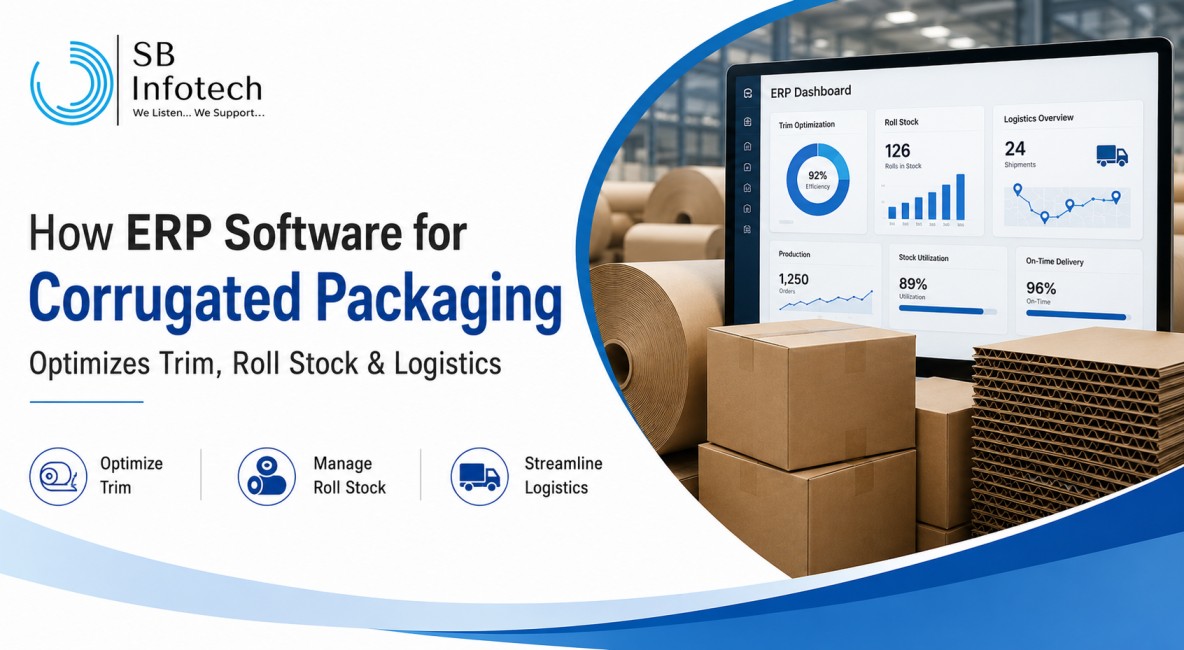
How ERP Software for Corrugated Packaging Optimizes Trim, Roll Stock & Logistics
Discover how ERP software for corrugated packaging optimizes trim, roll stock, inventory, production, and logistics to reduce waste and improve profitability.



Why Manual Processes Are Silently Killing Your Business — And What to Do About It
The hidden inefficiency that’s costing Indian SMEs ₹20–50 lakh every year without appearing on any report.
It is 9:15 AM. Ramesh, the owner of a mid-sized corrugated packaging company in Pune, walks into his office and is immediately pulled into a crisis.
His production manager cannot confirm whether yesterday’s raw material delivery was booked in stock. His accounts executive is on the phone with a vendor, trying to figure out why a payment that was processed last week does not show up in their records. His sales coordinator is manually updating a spreadsheet to prepare a dispatch summary — the same spreadsheet she updates every single day.
Meanwhile, a large client has emailed asking for a real-time stock availability confirmation before placing a ₹12 lakh order.
By the time Ramesh’s team locates the right information, cross-checks it across three different files, and sends a response — it is 2 PM. The client has already moved on to a competitor.
Ramesh did not lose that order because his product was inferior. He lost it because his business runs on manual processes.
Manual processes are the single most common operational problem in Indian SMEs — and the most underestimated. Most business owners know they have inefficiencies. Few realise how much those inefficiencies actually cost.
Here is what “manual” typically looks like across a growing Indian manufacturing or trading business:
This is not a small business problem. Companies with 50 to 500 employees, turning over ₹10–200 crore annually, regularly operate this way. And for a long time, it works — until suddenly, it does not.
Let us be specific about what manual operations actually cost. The damage shows up in three ways:
1:- Direct Financial Losses
A 2023 study by FICCI and EY found that Indian SMEs lose an estimated 15–25% of operational efficiency to manual data handling and process duplication. For a business with ₹10 crore in annual revenue, that translates to ₹1.5–2.5 crore in avoidable waste — through overstocking, billing errors, missed payment deadlines, and delayed invoicing.
Real example: A kraft paper manufacturer in Vapi discovered — after implementing ERP — that their team had been double-ordering the same raw material for over eight months, because two people managed inventory on separate files. Total over-procurement: ₹18 lakh. |
2:- Operational Breakdowns
3:- Strategic Paralysis
Perhaps the most damaging cost is invisible: the decisions you cannot make because you do not have clean data.
Which product line is most profitable? Which customer is consistently late on payment? Which raw material supplier offers the best landed cost after freight? Most SME owners cannot answer these questions — not because the data does not exist, but because it is trapped inside spreadsheets that no one has time to clean and analyse.
The answer to manual processes is not “work harder” or “hire more people.” It is to eliminate the manual process entirely — and replace it with a system that does the work automatically, in real time, with zero duplication.
This is what a modern ERP system — like Microsoft Dynamics 365 Business Central — does at its core. It connects every department of your business into a single, live data system.
Here is what changes when you automate:
Purchase to Payment — Automated
When a purchase order is raised in the system, it auto-generates the GRN (goods receipt note) upon delivery, updates inventory, triggers vendor payment scheduling, and reconciles the entry in accounts — all without a single re-entry of data.
Inventory — Real Time, Not End-of-Day
Every stock movement — inward, outward, production consumption, or returns — is captured the moment it happens. Your production manager and your sales team see the same inventory number, at the same time, from anywhere.
Reporting — Instant, Not Scheduled
Instead of waiting for your accounts team to prepare a monthly P&L, leadership can open a live Power BI dashboard and see revenue by product, cost by department, and gross margin by customer — updated to the hour.
Approvals — Workflow-Driven, Not WhatsApp-Driven
Purchase approvals, credit limit exceptions, and discount authorisations are routed automatically to the right person. Every decision is tracked, timestamped, and auditable.
The result for businesses that make this shift:
|
Before investing in any solution, run this 7-point diagnostic on your own business. If you answer ‘Yes’ to four or more, manual processes are already costing you significantly.
Scored 4+? Your manual processes are already generating measurable cost. The question is not whether to automate — it is how fast.
Ramesh from our story eventually made the shift. He implemented Microsoft Dynamics 365 Business Central with full inventory, procurement, and finance integration. Within three months, his team’s daily reconciliation time dropped from 4 hours to 20 minutes. Within six months, he had live dashboards that told him — at any moment — exactly which orders were profitable, which vendors were reliable, and which customers needed attention.
He did not just save time. He stopped losing business he did not even know he was losing.
Your competitors are not waiting. And neither are your customers.
Ready to Stop Running Your Business on Spreadsheets? SB Infotech helps Indian SMEs in manufacturing, packaging, and auto components implement Microsoft Dynamics 365 Business Central — with full process automation, India-localised compliance, and zero-disruption deployment. Book a Free Process Audit → shreebalajiinfotech.com/contact |
Discover how ERP software for corrugated packaging optimizes trim, roll stock, inventory, production, and logistics to reduce waste and improve profitability.
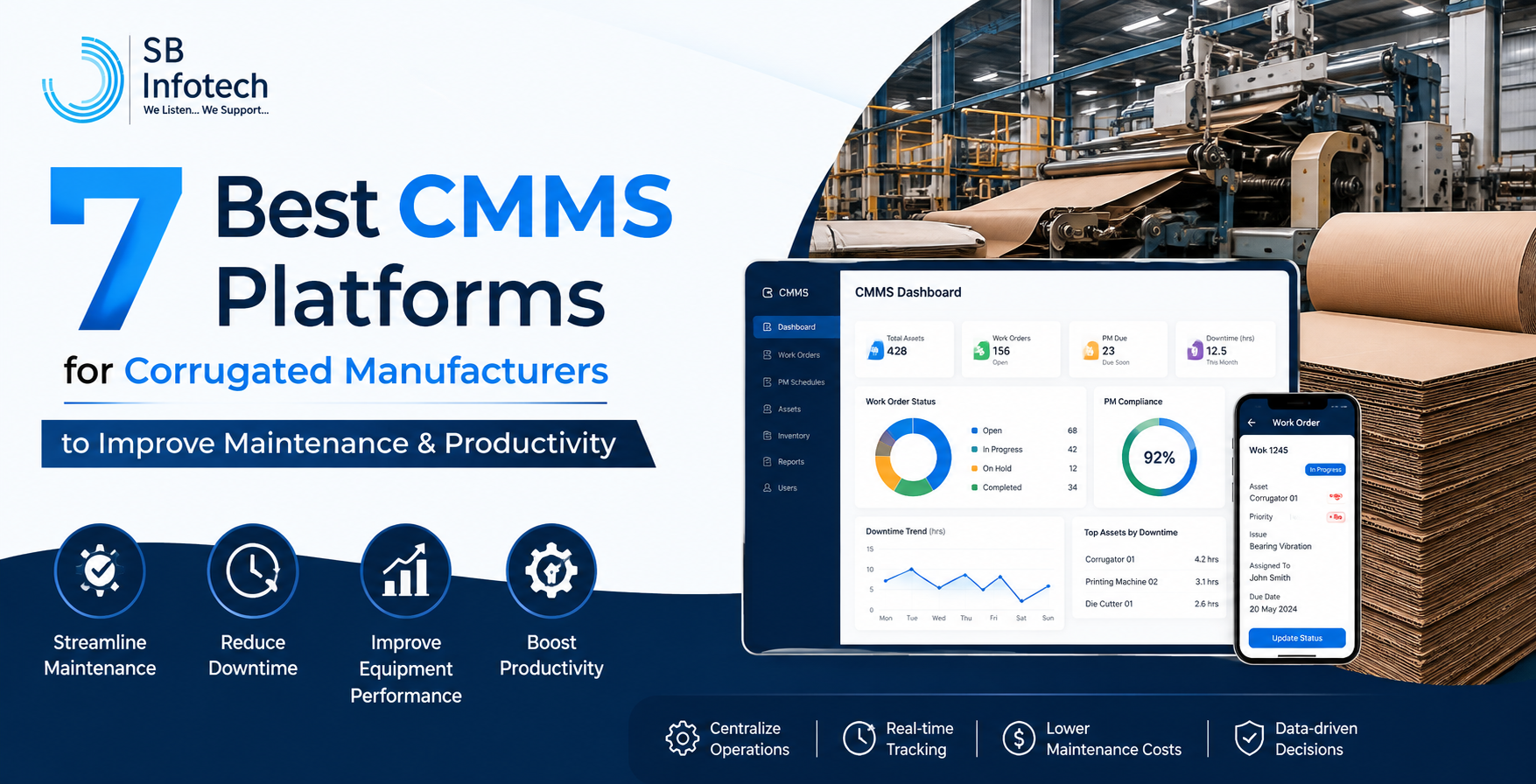
Discover the 7 best CMMS platforms for corrugated manufacturers to streamline maintenance, reduce downtime, improve equipment performance, and boost productivity.
WhatsApp us