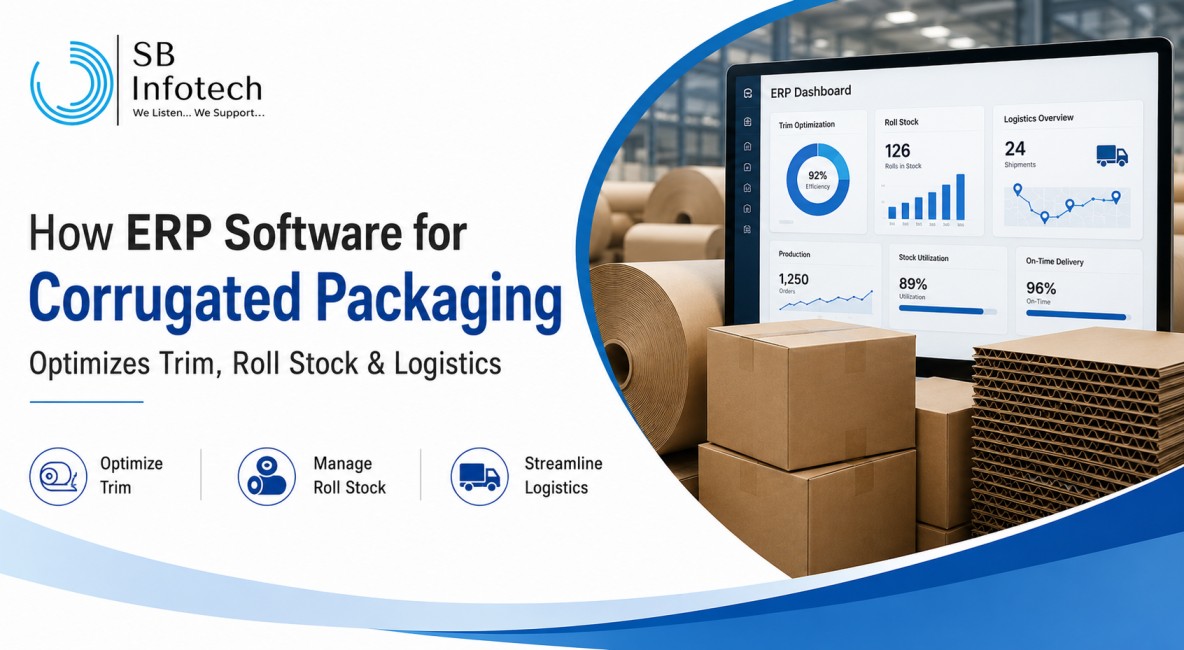
How ERP Software for Corrugated Packaging Optimizes Trim, Roll Stock & Logistics
Discover how ERP software for corrugated packaging optimizes trim, roll stock, inventory, production, and logistics to reduce waste and improve profitability.

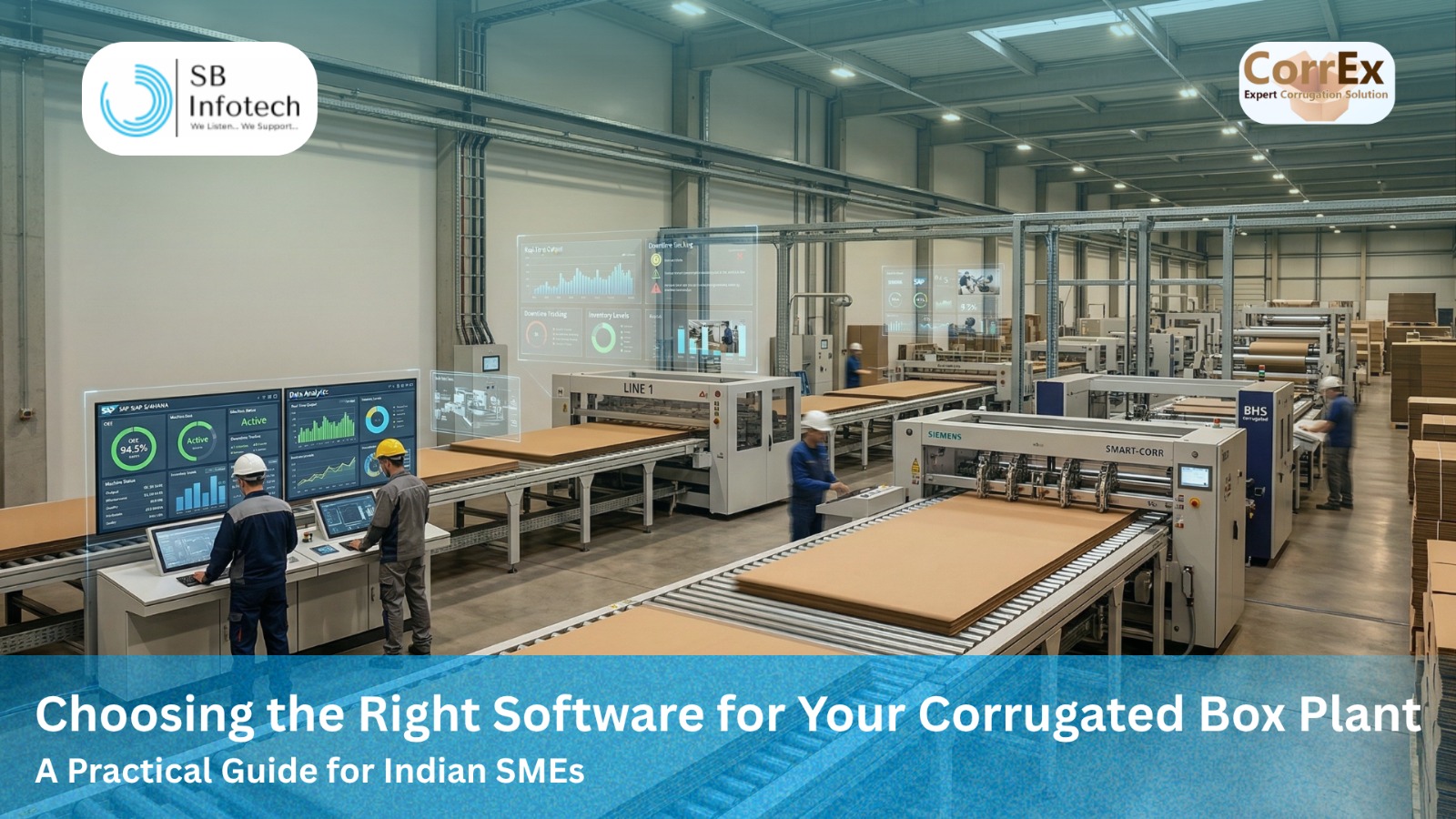

Picture this. It’s 9 AM at your plant. Your production supervisor is on WhatsApp telling you that the 150 GSM Kraft reel you planned for today’s run is actually 180 GSM—and the customer order calls for a specific board strength. Meanwhile, your costing sheet from last week doesn’t account for the extra trim waste from a deckle mismatch. And your dispatch team is waiting on an e-invoice that someone still generates manually in a separate Excel file.
This is not a hypothetical. If you run a corrugated box plant anywhere between Ludhiana and Coimbatore, between ₹5 crore and ₹200 crore in revenue, there’s a good chance some version of this scene plays out in your factory every few days.
The real question isn’t whether you need software. You probably already know you do. The question is: which software for corrugated box industry operations actually works for a plant like yours—and which one will burn your time, money, and patience?
This guide is not written by a software vendor. It’s written for plant owners, operations heads, and finance managers who are tired of being sold solutions that don’t understand how a corrugated box plant actually runs.
Here’s the honest truth that no software salesperson will tell you: a generic ERP is not built for corrugated box manufacturing.
Standard ERP systems are designed around discrete manufacturing—where you make a fixed item from fixed inputs. But corrugated box manufacturing is what’s called a process-driven, variable-input business. Your raw material (Kraft paper, fluting medium, liner) changes GSM batch by batch. Your reel yields vary. Your box costing changes with every deckle setting, every flute type, every customer spec. And your wastage is not a fixed percentage—it’s an outcome of how well you plan.
When a generic ERP vendor tells you “we handle manufacturing,” ask them one simple question: Can your system handle deckle optimization across multiple orders on the same corrugator run?
Nine times out of ten, they’ll look at you blankly—or give you a vague answer about “configurable modules.”
That blank stare is your answer.
Let’s be clear about what plant-level software needs to do for you. It’s not about dashboards or “real-time visibility.” Those are outcomes. The real work happens upstream.
Order-to-production translation: When a customer order comes in—say, 10,000 boxes of a specific size, bursting strength, and print specification—your system needs to automatically determine the right GSM combination, flute type, and board composition. Manually doing this for 50 orders a day is where errors creep in.
Reel and roll management: How much paper is actually left on each reel? What’s the usable width? How do you minimise trim loss when combining orders on the same corrugator run? This is deckle optimization—and it’s where 3-7% of your raw material cost either gets recovered or silently lost every month.
Production planning that reflects reality: A plan made on Monday morning is often obsolete by Monday afternoon. Machine breakdowns, paper quality variations, last-minute customer changes—your planning software needs to flex without needing a full replanning exercise.
Box costing that’s actually accurate: Most plants we’ve seen are costing boxes based on standard paper consumption rates that were set two years ago. But paper prices change, wastage rates change, reel width availability changes. If your costing doesn’t reflect real-time paper consumption and current prices, you’re either over-quoting (and losing orders) or under-quoting (and losing money). Neither is good.
Compliance without extra effort: GST filing, e-invoicing under the IRN system, e-way bills for dispatch—these aren’t optional. Any system you implement needs to handle these natively, not through a separate workaround.
Let’s be honest about what happens when a corrugated box plant buys a generic ERP. The sales pitch sounds reasonable. You get inventory, production orders, finance, GST — all under one roof. But the moment your production supervisor sits down to plan tomorrow’s corrugator run, the gaps start showing.
Deckle optimization, for instance, simply doesn’t exist in a generic system. It’s not a missing feature they forgot to build — it’s a concept that generic ERP vendors don’t even think about, because their system was designed for factories that make the same product every day. In corrugation, almost every run is different. Different box sizes, different paper widths, different order quantities. Figuring out how to combine orders on the same deckle setting to minimise trim waste is a daily puzzle — and your software either helps you solve it or it doesn’t.
The same story plays out with GSM-based costing. A generic ERP treats paper as a raw material with a fixed cost per kilogram. But in reality, your cost per box shifts every time your paper GSM changes, every time your reel width is slightly off, every time your wastage percentage moves. Industry-specific software is built to track these variables because that’s exactly how box plants actually work.
Reel and roll inventory is another area where the difference becomes painfully obvious. Generic systems track paper in kilograms or reams — broad, flat numbers. But your production team needs to know which specific reels are available, what width they are, what GSM, and how much usable paper is left on each one. Without that detail, planning is just guesswork dressed up as a schedule.
Then there’s implementation. A generic ERP typically takes anywhere from six months to a year and a half to go live, because your team ends up spending months configuring a system that was never designed for your industry. An industry-specific solution, already built around corrugation workflows, usually gets you operational in two to four months. That’s a meaningful difference when you’re trying to run a plant, not manage a software project.
The honest number that sticks with most plant owners: many corrugation businesses in the ₹10–50 crore range have spent ₹15–40 lakh on generic ERP implementations that their shop floor teams never fully adopted. The system sits in accounts and dispatch while production planning still happens on WhatsApp and Excel. That’s not a people problem. That’s a product-fit problem.
Scenario 1: Kraft Paper Mill supplying to corrugators
A paper mill manager’s nightmare is the same every quarter: reel quality variation across batches, GSM deviation complaints from box plants, and production efficiency calculations that depend on accurate basis weight data. If your production MIS is still done on Excel, you’re probably spending 3-4 days every month just compiling reports that should be automatic. The right system gives you shift-wise production data, reel-wise output tracking, and machine efficiency metrics without waiting for someone to manually enter data.
Scenario 2: Mid-size corrugation plant (₹20–80 crore turnover)
This is where the problem is most acute. You’re too big for Excel, but you haven’t been sold the right solution yet. Your pain points are typically: no real-time visibility into what’s on the corrugator versus what was planned, box costing that’s done “approximately,” and a finance team that reconciles paper consumption manually at month-end. A well-implemented industry-specific system reduces month-end closing time from 7-10 days to 2-3 days in most plants.
Scenario 3: Auto component packaging supplier (larger, more corporate)
If you’re supplying corrugated boxes to automotive OEMs or Tier 1 suppliers, you’re already dealing with strict delivery schedules, quality documentation requirements, and possibly vendor-managed inventory. Here, the emphasis shifts toward traceability, quality certificates, and integration with customer systems. This is where a system with a strong ERP backbone—but with corrugation-specific modules layered on top—makes more sense than a purely specialized tool.
Let’s talk numbers, because that’s what matters.
Raw material wastage: Plants running without deckle optimization typically report 8–14% paper wastage. After implementing proper production planning software with deckle optimization, most plants bring this down to 5–8%. On a plant consuming 300 MT of paper a month at ₹45/kg, that’s a potential saving of ₹4–12 lakh every single month.
Costing accuracy: When box costing is automated and connected to real-time paper prices and actual consumption data, pricing decisions become more confident. Several plant owners report being able to offer more competitive quotes on high-volume orders while maintaining margins—because they actually know their cost floor.
Production reporting time: Manual shift reports and production MIS that take 2–3 hours to compile daily can be reduced to near-zero manual effort. This frees up your supervisors to supervise, not to fill spreadsheets.
Order fulfillment delays: Poor planning—especially mismatches between what paper is available and what orders are scheduled—is a leading cause of delivery delays. Better planning software reduces this significantly. A realistic improvement is 20–30% reduction in production schedule deviations.
Inventory accuracy: Reel and roll inventory is notoriously hard to track accurately. A system that tracks each reel by ID, weight, width, and GSM eliminates the common problem of “ghost inventory”—paper that’s recorded as available but isn’t actually usable.
Every software vendor will show you a good demo. It will look clean, professional, and comprehensive. Here’s what to do instead of getting swayed by the demo:
Ask for a pilot run with your actual data. Feed in last month’s production orders and ask the system to generate a deckle plan. See if it makes sense to your production team.
Talk to references in your specific industry. A reference from a steel plant or a pharma company is not relevant for a corrugated box plant. Ask specifically for references from corrugation or paper plants of similar size.
Check your finance team’s requirements first. GST, e-invoicing, TDS—if these aren’t built in and tested, you’ll end up with a hybrid system that causes more problems than it solves.
Understand the implementation reality. A vendor who promises to “go live in 30 days” is either oversimplifying or setting you up for a painful experience. Realistic implementation for a plant of 50–200 people with multiple machines is 3–6 months.
For operations heads and CFOs coming from a more corporate background—particularly in auto components or larger packaging companies—there’s a natural comfort with Microsoft-ecosystem products. Dynamics 365, Power BI, and Office 365 are already in use in many of these organizations.
The good news is that some industry-specific solutions for corrugated box manufacturing are now built on top of Microsoft Dynamics, which gives you the credibility and security of an enterprise platform with the operational depth of corrugation-specific functionality. This hybrid approach is worth exploring if your organization is already Microsoft-aligned and your IT team is familiar with that ecosystem.
If your plant is below ₹5 crore in revenue, you probably need better processes more than you need software right now. Get your data collection clean first.
If you’re between ₹5–30 crore, a focused, industry-specific corrugation software will give you the best return. You don’t need the overhead of a full-scale ERP. You need something that your production supervisor will actually use.
If you’re between ₹30–200 crore—especially if you have multiple machines, multiple plants, or supply to organized sector customers—a proper ERP with corrugation-specific modules is worth the investment. But be very selective about vendors, and insist on proven corrugation industry references before you sign anything.
The corrugated box industry in India is growing fast—driven by e-commerce, FMCG packaging shifts, and the push toward sustainable packaging. But the software landscape hasn’t caught up cleanly. Too many generic vendors are selling “manufacturing ERP” to box plant owners who don’t realize they’re buying a solution built for a different industry.
The right software for corrugated box industry operations is one that understands deckle optimization, reel management, GSM-based costing, and production planning the way your plant actually works—not the way a textbook manufacturing module was designed.
Take your time with this decision. Talk to other plant owners. Demand a pilot. And remember: the goal isn’t to implement software. The goal is to run a more profitable, less chaotic plant. The right software makes that happen quietly, in the background, every day.
Discover how ERP software for corrugated packaging optimizes trim, roll stock, inventory, production, and logistics to reduce waste and improve profitability.
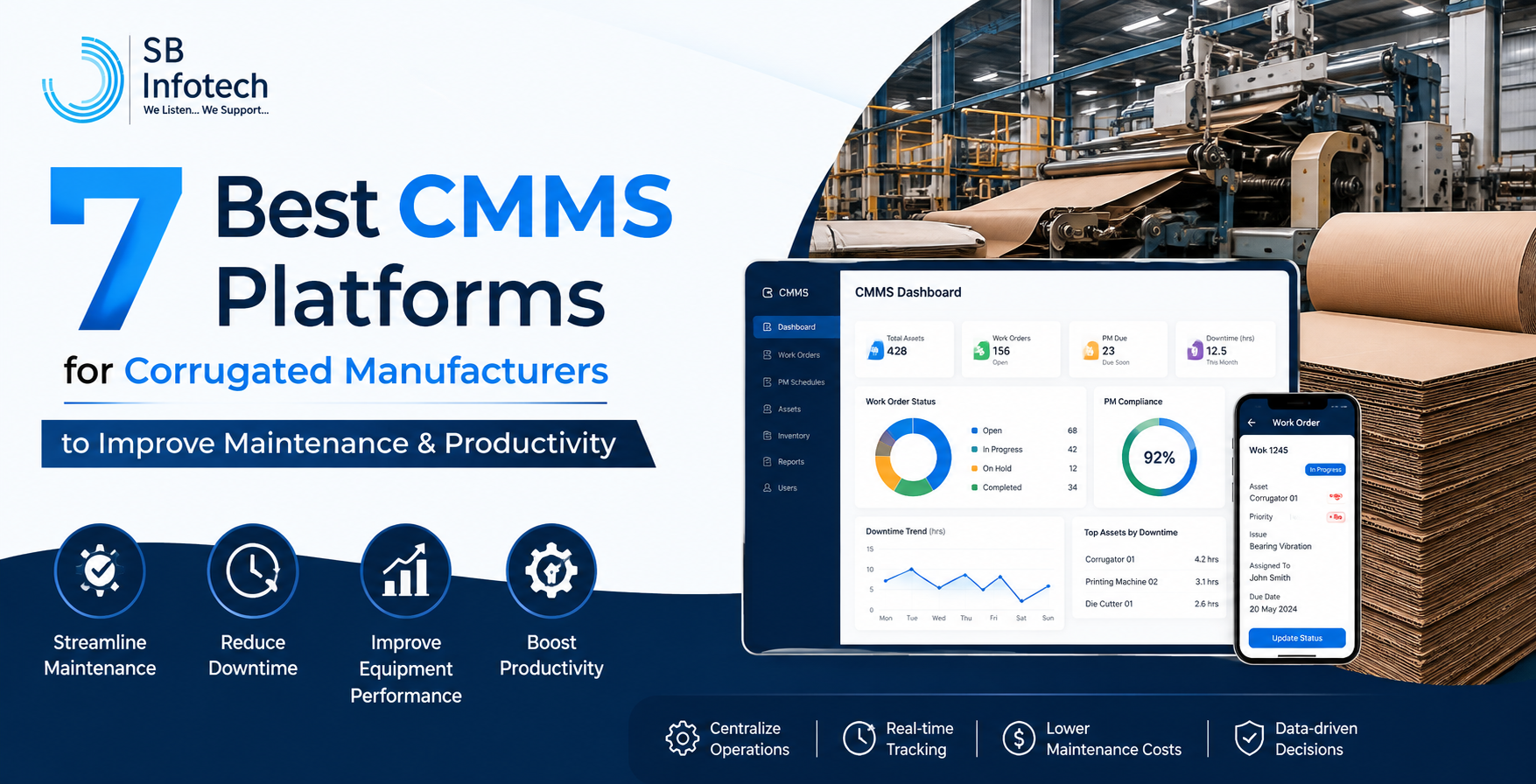
Discover the 7 best CMMS platforms for corrugated manufacturers to streamline maintenance, reduce downtime, improve equipment performance, and boost productivity.
WhatsApp us