Our Blogs

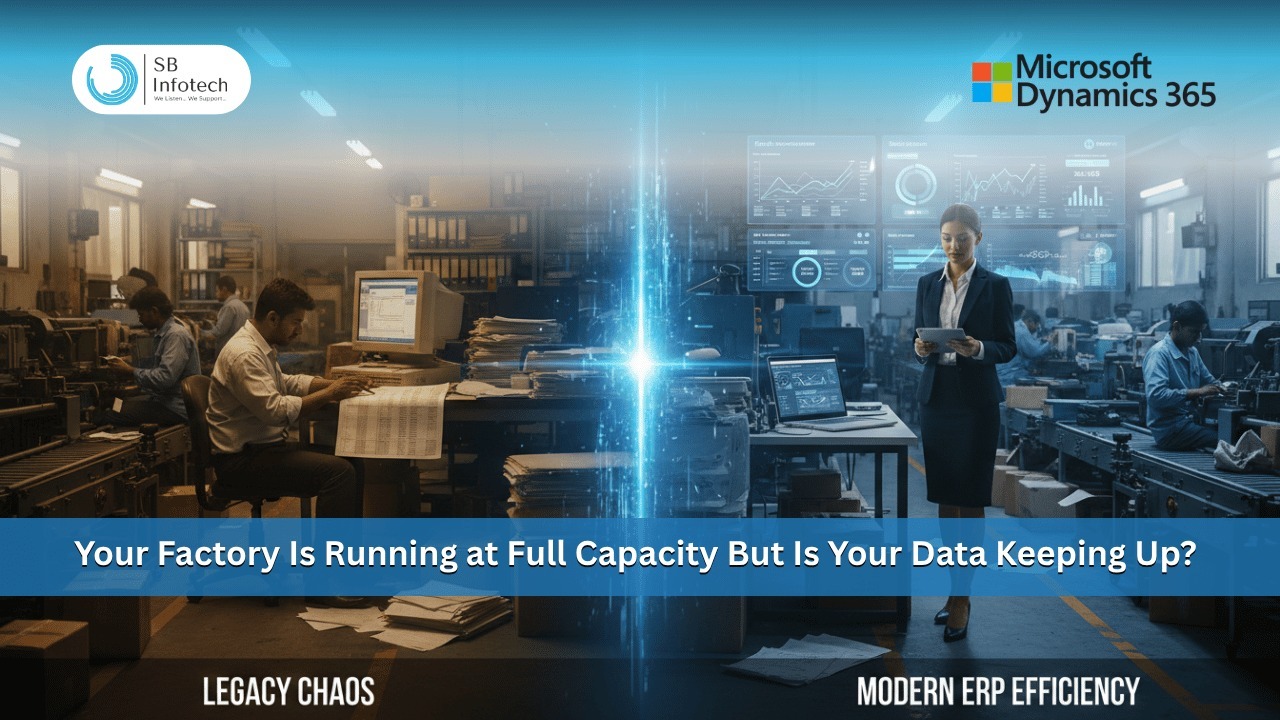
Your Factory Is Running at Full Capacity But Is Your Data Keeping Up?

Your Factory Is Running at Full Capacity But Is Your Data Keeping Up?
SB Infotech 3rd Sept

Walk into your factory on any given day, and everything seems to be moving at full speed.

  • Machines are running.
  • Orders are being processed.
  • Teams are working hard to meet deadlines.
  • On the surface, operations look efficient.


But step into the office — and a different reality starts to emerge.


Your accounts team is still working in Tally, manually reconciling entries. Your sales team doesn’t have clear visibility into inventory.
And your leadership team? They’re waiting until the end of the month to understand what’s actually happening in the business.


The factory is fast. The data is not.

And that gap is where real problems begin.

The Invisible Bottleneck Slowing Down Growth

For many Indian SME manufacturers, this situation is not unusual.


In fact, it has become the default way of operating.

  • Not because businesses are inefficient.
  • Not because teams lack capability.

But because the systems they rely on were built for a different era.


Legacy tools like Tally or older ERP systems were never designed to handle the complexity of modern manufacturing operations. They were built when businesses were smaller, processes were simpler, and real-time decision-making was not critical.


Today, the environment has changed completely.

  • Customers expect faster delivery.
  • Supply chains are more dynamic.
  • Compliance requirements are stricter.
  • And competition is more aggressive than ever.


Yet many businesses are still trying to manage all of this with disconnected systems.

This is where the real bottleneck lies — not on the shop floor, but in the flow of information.

What Outdated ERP Systems Are Really Costing You

At first glance, your current system might seem “good enough.” After all, it’s familiar. Your team knows how to use it. And it’s been part of your operations for years. But beneath that comfort lies a growing set of inefficiencies.

1. Data Silos Across Departments

When finance, sales, inventory, and production operate in separate systems, information stops flowing.


  • Your sales team cannot see real-time stock.
  • Your production team doesn’t have visibility into demand fluctuations.
  • Your finance team works with delayed or incomplete data.


This lack of integration leads to misaligned decisions across the business.

2. Manual Reconciliation Becomes Routine

nstead of focusing on analysis or strategy, your team spends hours every week matching data across spreadsheets and software.


Purchase orders, invoices, inventory levels — everything needs to be verified manually.


This not only consumes time but also increases the risk of human error.

What should take minutes ends up taking hours.

3. No Real-Time Visibility

In today’s business environment, decisions need to be made instantly. But with outdated systems, insights are always delayed. By the time reports are generated, the situation has already changed. Opportunities are missed. Issues escalate. And decisions are made based on outdated information.

4. Compliance Becomes a Burden

With GST regulations, e-invoicing, and other statutory requirements, compliance is no longer optional — it’s critical.

Legacy systems often require additional tools or manual workarounds to stay compliant. This increases complexity and exposes the business to risks.


Compliance should be built into your system — not managed outside of it.

5. Missed Opportunities You Don’t Even See

Perhaps the biggest cost is the one that doesn’t show up on any report. When your systems are slow, disconnected, or incomplete, you lose visibility. And when you lose visibility, you lose opportunities.

  • Opportunities to improve efficiency.
  • Opportunities to serve customers better.
  • Opportunities to grow faster.


These losses are silent — but they compound over time.

Why Modern Manufacturers Are Moving to Smarter ERP Systems

To address these challenges, many forward-thinking businesses are making a shift. They are moving away from legacy tools and adopting modern, cloud-based ERP solutions like Microsoft Dynamics 365 Business Central.

This is not just a technology upgrade. It is a shift in how the business operates.

What Makes Microsoft Dynamics 365 Business Central Different

If your plant is below ₹5 crore in revenue, you probably need better processes more than you need software right now. Get your data collection clean first.


If you’re between ₹5–30 crore, a focused, industry-specific corrugation software will give you the best return. You don’t need the overhead of a full-scale ERP. You need something that your production supervisor will actually use.


If you’re between ₹30–200 crore—especially if you have multiple machines, multiple plants, or supply to organized sector customers—a proper ERP with corrugation-specific modules is worth the investment. But be very selective about vendors, and insist on proven corrugation industry references before you sign anything.

Modern ERP systems are designed for the way businesses operate today — connected, fast, and data-driven.

Here’s what sets them apart:

 
1. Real-Time Data Across the Organization

Every department works on the same system.

When a sales order is created, inventory updates instantly.
When production is planned, finance reflects the impact immediately.

Everyone works with the same, up-to-date information.

 
2. Built-In Compliance for Indian Businesses

With features like GST support, e-invoicing, and TDS/TCS integration, compliance is handled within the system.

There is no need for separate tools or manual adjustments.

This reduces risk and simplifies operations.


3. Cloud Access for Greater Flexibility

Whether you are on the factory floor, in the office, or traveling, your business data is always accessible.

Managers can track performance, monitor operations, and make decisions from anywhere.

The business is no longer tied to a physical location.

 
4. Scalability Without Complexity

As your business grows, your ERP grows with you.

Adding new products, warehouses, or locations does not require a complete system overhaul.

The system adapts — without disrupting your operations.

ERP Is No Longer Just Accounting Software

For a long time, ERP systems were seen as tools for managing accounts. That perception no longer holds true. Today, ERP is the core system that connects your entire business.

It influences:

  • How quickly you respond to customers
  • How efficiently you manage inventory
  • How accurately you plan production
  • How confidently you make decisions


In other words, it becomes your decision-making engine. And like any engine, its performance directly impacts your growth.

If your ERP is slow, your business will be slow.

The Real Question You Should Be Asking

Many business owners still approach ERP migration with hesitation.

 
They ask:

“Is this the right time?”
“Can we manage the transition?”
“Is it worth the investment?”

But these questions miss the bigger picture.


The real question is not:

“Should you migrate?”

The real question is:


How long can you afford not to?

Because every month spent on an outdated system is a month of:

  • Delayed decisions
  • Reduced efficiency
  • Missed growth opportunities

Recognizing the Right Time to Act

If your business is experiencing any of the following, it may be time to rethink your current system:


  • Increasing reliance on spreadsheets
  • Frequent data mismatches
  • Delayed reporting cycles
  • Difficulty in managing compliance
  • Limited visibility across departments


These are not isolated issues. They are signals that your current system is no longer supporting your growth.

Taking the First Step Toward Transformation

Migrating to a modern ERP system may seem like a big step. But in reality, it is a structured and manageable process when done correctly. With the right implementation approach, businesses can transition smoothly — without major disruptions.

The key is to start with clarity:

  • Understand your current challenges
  • Define your business requirements
  • Work with the right implementation partner

From there, the journey becomes much more predictable.

Conclusion: Don’t Let Your Systems Hold You Back

Your factory is already operating at full potential. Your team is putting in the effort. Your processes are in motion. But if your systems are not aligned with that effort, growth will always feel harder than it should.


Modern businesses are not just defined by what they produce — but by how efficiently they operate.

And that efficiency starts with the right ERP system.

A Final Thought

If you are still relying on Tally or legacy ERP systems, this might be the moment to pause and reflect. Not on what your system has done for you in the past —


But on what it is costing you today. Because in a fast-moving business environment, the gap between action and delay is where competitive advantage is won or lost.

Related Blogs